
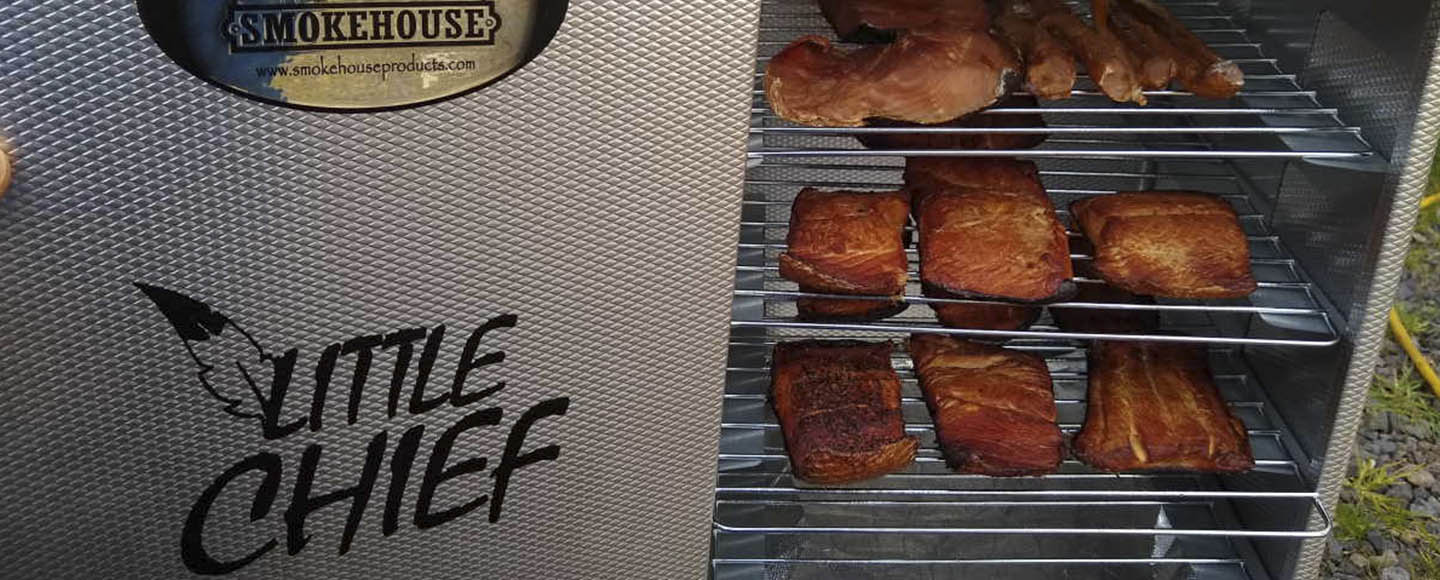
Little Chief Smoker Review
I’ve had a Little Chief in rotation for years, mostly because I can’t bring myself to get rid of it. Here’s the short version before we get into the weeds.
Quick Verdict
Smokehouse Little Chief Smoker
Overall Rating: 3.8/5 — great at what it does, limited in what it can do
Best For: Salmon, jerky, sausage, and anyone who wants a plug-in-and-walk-away smoker
Not Ideal For: Brisket, pork shoulder, or anyone smoking in a cold climate
Key Specs: Fixed 165°F heating element, 25 lb capacity, aluminum construction, 4 chrome-plated racks
Current Price Range: $80–$110
- Extremely simple operation — plug it in, load your chips, done
- Consistent low-temperature smoking, which is exactly what fish and jerky need
- Lightweight and genuinely portable
- Affordable entry-level smoker
- Excellent for fish and jerky specifically
- No temperature adjustment at all
- Limited cooking versatility beyond low-and-slow, thin-cut foods
- Struggles in cold or windy weather
- Not built for large cuts like brisket or pork shoulder
If you just want the number: it’s still one of the best cheap smokers for fish and jerky in 2026. It’s not a barbecue smoker, and if you buy it expecting to smoke a brisket, you’re going to be disappointed. Keep that distinction in mind and you’ll be happy with it.
What Is the Little Chief Smoker?
The Little Chief has been around since the 1960s, made by Smokehouse Products out of Washington State. It was designed with one job in mind: smoking salmon for Pacific Northwest anglers who needed a simple way to preserve their catch. That history matters, because it explains almost everything about how this smoker behaves today.
It’s built a genuine cult following among home smokers, especially in fishing communities, because it does that one job really well and it’s been basically unchanged for decades. There’s something to be said for a product that hasn’t needed a redesign in 60 years.
Where it differs from modern electric smokers — and this is the big one — is that it has no thermostat. Most electric smokers built in the last 15 years let you dial in a temperature. The Little Chief has a single fixed heating element that runs at roughly 165°F no matter what you do. You’re not choosing a cook temperature; you’re choosing to work within its one temperature.
Front-Load vs. Top-Load Models: Which Should You Buy?
Here’s something that trips up a lot of first-time buyers, and honestly, it’s the question I get asked most often about this smoker: Smokehouse makes both a Front-Load and a Top-Load version of the Little Chief.
They look nearly identical in online listings, so it’s an easy mistake to make. The difference matters more than you’d think:
- Front-Load: You open a door on the front and slide the racks out like a filing cabinet. This is the version I’d point almost everyone toward. You can check on your fish or jerky, rotate racks, or pull a finished batch without losing your top heat or accidentally dropping a rack of salmon into the wood chip pan below.
- Top-Load: You lift the whole top lid off to access the racks. It works, but every time you open it, heat escapes straight up and out, and there’s real risk of jostling delicate items like fish fillets.
If you’re buying new, spend the extra few dollars and get the Front-Load. If you’re buying secondhand and see a great deal on a Top-Load, it’s not a dealbreaker — just know what you’re getting into.
Key Features & Specifications
Cooking Capacity
The Little Chief holds about 25 lbs of food across its racks, which is plenty for a weekend batch of salmon or a few pounds of jerky. It’s not designed for feeding a crowd off one load.
Heating Element Output
You’re looking at roughly 250 watts, fixed. No high or low setting — it’s on or it’s off.
Rack Design
Four chrome-plated racks that slide in and out (on the Front-Load model, at least). They’re spaced well enough for fish fillets and jerky strips without overcrowding, as long as you don’t try to cram in more than the smoker’s built for.
Construction Quality
Single-wall aluminum. Light, rust-resistant, and easy to move — but it also means there’s zero insulation, which we’ll talk about more in the temperature control section.
Weight & Portability
This is one of the lightest smokers you’ll find, easily under 10 lbs empty. I’ve carried mine to a friend’s cabin in one hand along with a bag of chips in the other. If you’re looking for a portable smoker, this is highly competitive.
Wood Chip System
A simple metal pan sits at the bottom, directly under the heating element. You load wood chips (not chunks or pellets) into the pan, and the element smolders them slowly. For the best results, check out our guide on where to buy wood for smoking meat.
Power Requirements
Standard household outlet, nothing special. This is a real advantage over charcoal or pellet rigs if you’re smoking on an apartment balcony or somewhere without gas or charcoal access. It ranks highly among balcony-friendly electric smokers.
Setup and First Impressions
Unboxing Experience
It comes in a surprisingly small box for what it does — more on that box later, because you’re going to want to keep it. Inside, you get the smoker body, racks, the chip pan, and a basic instruction sheet.
Assembly Process
There isn’t much assembly to speak of. You slide the racks in, plug it in, and you’re smoking within ten minutes of opening the box. For a first-time smoker owner, this is genuinely refreshing after wrestling with some of the pellet rigs I’ve tested that need an hour of bolt-tightening before they even turn on.
Learning Curve
About as close to zero as a smoker gets. If you can use a toaster, you can use a Little Chief. The only real learning curve is understanding what it’s good at (thin cuts, fish, jerky) versus what it’s not (thick cuts, anything needing higher heat). It’s arguably one of the best smokers for beginners because of this simplicity.
Initial Build Quality Assessment
It feels exactly like what it is: a simple, no-frills aluminum box. Don’t expect the heavy-gauge steel feel of a $400 smoker. But for the price, nothing rattles loose or feels cheap in a way that worries me.
Cooking Performance Review
How Hot Does the Little Chief Smoker Get?
In ideal conditions — mild weather, no wind, smoker out of direct sun exposure issues — the Little Chief holds around 160-170°F internally. That’s the whole range. There’s no dial to push it hotter for a quicker cook or lower for a gentler one.
Weather conditions have a bigger impact on this smoker than almost any other I’ve tested, precisely because of that uninsulated aluminum shell. On a cold or windy day, I’ve seen internal temps drop into the 120-130°F range, which starts to move you out of safe smoking territory for some foods and definitely slows your cook time significantly.
Smoking Fish
This is where the Little Chief earns its reputation. Salmon smoking is genuinely what this thing was built for, and it shows. The low, steady heat is ideal for turning out that classic smoked salmon texture — moist, not dried out, with deep smoke penetration without ever approaching “cooked and flaky” the way a hot smoker would push it.
I’ve run several batches of salmon through mine, brined overnight and smoked for 4-6 hours depending on fillet thickness, and the results consistently rival smoked salmon I’ve paid real money for at specialty shops. For the best flavor pairings, reference our best wood for smoking salmon guide.
Smoking Jerky
Jerky is the other headline use case, and it performs nearly as well as it does with fish. The fixed low temp is essentially a dehydrator with smoke flavor built in, which is exactly the profile jerky needs.
Drying efficiency is solid, though not perfectly even — racks closer to the heating element at the bottom tend to dry faster than the top rack. My workaround: rotate racks halfway through the cook, top to bottom. It’s a small extra step but makes a noticeable difference in consistency across racks. If this is your main goal, see our top picks for the best smoker for jerky.
Smoking Sausage and Snack Sticks
Snack sticks and small-diameter sausages do well here for the same reason jerky does — thin, and they don’t need a hot cook to render properly. I’ve had good luck with venison snack sticks specifically. Thicker sausage links can work too, but you’ll want a meat thermometer on hand since the fixed heat means cook times vary more than you’d expect.
Can You Smoke Brisket or Pork Shoulder?
Short answer: not well, and I wouldn’t recommend it. I tried a small pork shoulder in mine during testing, specifically so I could give you an honest answer here instead of guessing. The problem is twofold. First, 165°F is too low to safely and efficiently push a large cut through the “stall” the way a real barbecue smoker would. Second, without any way to add heat, you’re at the mercy of ambient conditions for a cook that can already take 12+ hours on proper equipment.
Some users work around this by finishing the cut in an oven after getting smoke flavor into it on the Little Chief for the first few hours. It’s a legitimate workaround if you’re determined to make it happen, but if brisket and pork shoulder are your primary goal, this isn’t the smoker for that job — and I’ll point you toward better options for that later in this review. For traditional BBQ, you’re better off learning how to smoke a brisket on a dedicated rig.
Free Download: Perfect Salmon Brine Recipe
Get the exact overnight brine recipe we use to test this smoker. Sent straight to your inbox.
Temperature Control: The Biggest Limitation
Why the Little Chief Uses a Fixed Temperature System
This comes back to the original design intent. Smokehouse built this thing in the 1960s to do one job — cold-ish smoke fish — and never needed to add a thermostat because that one job doesn’t require variable heat. It’s a feature by omission more than a flaw, but it does mean the smoker is fundamentally single-purpose.
What Foods Benefit From Low-Temperature Smoking
Fish, jerky, cheese (with caveats, more below), snack sticks, and other thin or already-cured items that just need smoke flavor and gentle drying rather than full cooking. Anything where you want smoke penetration without significant protein breakdown is a good match. Understanding the difference between cold smoking vs hot smoking is critical here.
When a Traditional Smoker Is a Better Choice
The moment you want to cook a large cut of meat from raw to fully cooked — brisket, pork shoulder, ribs, whole chickens — you need a smoker with adjustable heat, ideally one that can climb into the 225-275°F range. That’s simply outside what the Little Chief can do, and no amount of technique will change that.
Can You Cold Smoke in a Little Chief?
Here’s a question I get a lot, and the honest answer is: sort of, with a workaround. Technically, 165°F is a warm smoke or dehydration temperature — it’s actually too hot for true cold smoking of things like cheese or cured butter, where you want to stay well under 90°F to avoid melting or cooking the product.
If you want to cold smoke in a Little Chief, the trick is to bypass the built-in heating element entirely. A couple of ways I’ve seen this done, and tested myself:
- Use a pellet smoke tube, like an A-MAZE-N tube, filled with pellets and lit separately, placed inside the smoker with the heating element unplugged or unused. The tube smolders on its own and just uses the Little Chief’s body as a smoke chamber.
- Some owners rig up a separate cold smoke generator and pipe smoke into the Little Chief through a small hose or adapted opening, again without engaging the internal element.
If cold-smoked cheese is your goal, this workaround is worth trying before you buy a dedicated cold smoker. Just don’t expect it to work well straight out of the box using the stock heating element — that’s built for warm smoking, not cold smoking.
Smoke Flavor Quality
Wood Chip Consumption
The Little Chief burns through chips steadily, and you’ll need to refill the pan roughly every 45 minutes to an hour for continuous smoke on longer cooks. It’s not the most fuel-efficient system out there, but chips are cheap, so it’s rarely a real cost concern. If you want to upgrade your fuel, read our guide on the best lump charcoal for smoking.
Smoke Production
Smoke output is consistent and moderate — not the billowing clouds you’d get from a stick burner, but enough steady smoke to properly flavor fish and jerky over a multi-hour cook.
Flavor Penetration
Because cook times run long at low heat, smoke has plenty of time to penetrate. This is actually one of the underrated advantages of the fixed-temp design — you get deep, well-developed smoke flavor rather than a light surface dusting.
Best Wood Types to Use
Alder is the traditional choice for salmon and it’s what I’d reach for first if you’re smoking fish specifically — it’s mild and matches the fish beautifully. Apple and cherry work well for jerky and give a slightly sweeter profile. Hickory is fine for snack sticks and sausage if you want something bolder. I’d avoid mesquite here; it’s strong enough that it can overpower thin cuts and delicate fish over these long cook times. Check our wood smoking flavor chart for more pairings.
Ease of Use
Beginner-Friendly Design
This might be the single easiest smoker to operate that I’ve ever tested. There’s no temperature dial to fuss over, no fire to manage, no fuel to monitor beyond wood chips. Load it, plug it in, check on it periodically. For a deeper dive, read our guide on how to use an electric smoker.
Maintenance Requirements
Minimal. Wipe down the racks, empty the chip pan, and periodically clean built-up residue from the interior walls. It’s a low-maintenance appliance by design.
Preventing Grease Fires & Over-Smoking
One thing I see beginners get wrong constantly: confusing the wood chip pan with the drip tray, or not managing either one properly. Don’t let grease and drippings accumulate directly near the heating element — that’s a real fire risk, especially with fattier cuts like sausage or salmon with the skin on.
- Line your drip tray with heavy-duty foil before every cook. It catches grease and residue, and you just pull it out and toss it instead of scrubbing the tray itself.
- Watch for creosote buildup on the aluminum interior walls over repeated cooks. A thin layer adds flavor over time, but heavy buildup turns bitter and can flake into your food. A wipe-down every few cooks keeps this in check.
Cleaning the Little Chief
Cleaning is straightforward — the racks come out and wipe down easily, and the aluminum body doesn’t require anything special. Just avoid harsh abrasives that could scratch the interior. See our full tutorial on how to clean an electric smoker.
Long-Term Ownership Experience
Owners who’ve had theirs for years (myself included) generally report the same thing: it keeps doing exactly what it did on day one, as long as you don’t neglect basic cleaning. It’s not a smoker that develops new problems with age so much as one that simply has the same limitations it always had.
Durability and Build Quality
Aluminum Construction
Single-wall aluminum keeps it light and rust-resistant, which is genuinely nice for a smoker that might live outdoors. The tradeoff, as we’ve covered, is no insulation whatsoever.
Weather Resistance
It handles rain and general outdoor exposure fine. What it doesn’t handle well is cold or wind actually affecting your cook — that’s a performance issue more than a durability one, but it’s worth repeating here.
Common Complaints From Long-Term Owners
The most common complaint I hear (and have experienced myself) is temperature inconsistency in anything but mild, calm weather. A smaller but real complaint is that the racks can warp slightly after years of heat cycling, though this doesn’t typically affect function.
Expected Lifespan
With basic care, these smokers routinely last a decade or more. It’s not unusual to find secondhand units from the 1990s still working fine — that’s a real testament to how simple and over-built the core design is.
Energy Efficiency and Operating Costs
Electricity Usage
At roughly 250 watts running continuously over a multi-hour cook, you’re using a modest amount of electricity — comparable to running a space heater on low for the same duration.
Cost Per Smoking Session
For a typical 5-6 hour salmon smoke, you’re looking at well under a dollar in electricity costs at most residential rates, plus the cost of wood chips (usually just a few dollars per bag, and a bag lasts multiple sessions).
Comparison to Pellet and Charcoal Smokers
It’s meaningfully cheaper to run than a pellet smoker, which burns through pellets at a faster rate and often needs more electricity to run the auger and fan system. It’s also more predictable cost-wise than charcoal, where you’re buying briquettes or lump charcoal every session.
Little Chief Smoker vs Competitors
Little Chief vs Big Chief Smoker
The Big Chief is Smokehouse’s larger sibling — same 165°F fixed-temperature concept, but with roughly double the capacity (50 lbs vs 25 lbs) and a beefier 450-watt heating element across 5 racks instead of 4. If you love how the Little Chief works but keep running out of room, the Big Chief is the obvious next step rather than switching brands entirely.
Little Chief vs Masterbuilt Analog Electric Smoker
This is a real fork in the road. The Masterbuilt gives you an adjustable temperature dial (up to around 275°F) and insulated dual-wall steel construction, which means it can actually handle traditional low-and-slow barbecue like pork shoulder and brisket — territory the Little Chief simply can’t touch. If versatility matters more to you than dead-simple operation, the Masterbuilt is worth the step up.
Little Chief vs Bradley Smoker
Bradley smokers use an automatic wood bisquette feeder, which takes wood management off your plate entirely for hours at a stretch, and they separate the smoke-generating element from the cooking element. That separation makes Bradley smokers notably better for precise low-temp work and cold smoking than the Little Chief’s all-in-one fixed element.
Little Chief vs Pellet Smokers
Pellet smokers like Traeger or Pit Boss models operate on a completely different level of versatility — true convection cooking across a wide temperature range, from searing heat down to low-and-slow. They cost more and need more setup, but they can do everything the Little Chief does and everything it can’t. See our top picks for the best pellet smoker.
Who Should Buy the Little Chief Smoker?
Best For
Salmon smokers who want that classic PNW-style smoked fish. Jerky makers who want consistent, low-effort drying with smoke flavor. Beginners who want zero learning curve. Occasional smokers who don’t want to commit to a complex setup.
Not Recommended For
Brisket enthusiasts and anyone focused on traditional low-and-slow BBQ. Competition BBQ cooks who need precision and versatility. Large families needing high-volume output in one load. Anyone smoking primarily in cold-weather climates without a workaround.
Common Problems and Solutions
Smoker Not Getting Hot Enough
If your Little Chief seems sluggish, check for wind exposure first — even a light breeze against that thin aluminum shell pulls heat away fast. Move it somewhere sheltered, like against a wall or under a covered patio, before assuming something’s wrong with the unit itself.
The Cardboard Box Insulation Trick
This is a classic workaround, especially popular among Pacific Northwest owners who deal with cold, damp weather most of the year: keep the original shipping box the smoker came in, cut it to fit, and use it as an insulating shroud around the smoker body during cold-weather cooks. It sounds low-tech because it is, but it genuinely helps trap heat against that uninsulated aluminum shell and keeps internal temps more stable. If you’d rather not rely on a cardboard box, Smokehouse also sells an insulating thermal blanket shroud designed specifically for this purpose — worth grabbing if you plan to smoke through the colder months regularly.
Uneven Drying
As mentioned earlier, rotate your racks top to bottom partway through longer cooks. The bottom rack, closer to the heating element, dries faster than the top.
Smoke Production Issues
If you’re not getting steady smoke, check that your chip pan isn’t overloaded — packing it too full can actually smother the smolder instead of helping it. A thin, even layer works better than a heaping pile. For more tips, see our electric smoker tips.
Weather-Related Performance Problems
Beyond the cardboard box trick, simply choosing a sheltered spot and avoiding smoking on your coldest, windiest days will solve most of the temperature complaints owners run into.
Frequently Asked Questions
Is the Little Chief Smoker good for beginners?
Yes — it’s one of the easiest smokers on the market to operate, with no temperature settings to manage and a genuinely short learning curve.
What temperature does the Little Chief Smoker reach?
It runs at a fixed temperature of roughly 165°F under normal conditions, with no adjustment available.
Can you cook brisket in a Little Chief Smoker?
Not effectively. The fixed low temperature and lack of insulation make it a poor fit for large cuts like brisket or pork shoulder. A finish-in-the-oven workaround exists, but it’s not what this smoker is built for.
Is the Little Chief Smoker worth the money?
For its specific use case — smoking fish, jerky, and sausage — yes, it’s genuinely one of the best values available. For general barbecue, no, it’s the wrong tool.
How long does a Little Chief Smoker last?
With basic maintenance, a decade or more is common. Many owners run units that are 15-20+ years old.
What’s the difference between the Little Chief and Big Chief?
The Big Chief is larger — roughly double the cooking capacity — with a stronger heating element, but it operates on the same fixed-temperature concept as the Little Chief.
Final Verdict: Is the Little Chief Smoker Worth Buying?
After running mine through everything from salmon to jerky to a doomed attempt at pork shoulder, my take is this: the Little Chief is a genuinely excellent tool for a narrow job, and a poor choice outside that job. It’s not trying to be a do-everything smoker, and honestly, that focus is part of its charm.
Buy It If
You primarily smoke fish or jerky. You want a simple plug-and-play smoker with zero learning curve. You prefer affordable, low-maintenance equipment.
Skip It If
You want any real temperature control. You cook traditional low-and-slow BBQ regularly. You need high-capacity cooking for a crowd.
If you fall into that first list, check the latest price and grab one — at under $110 in most cases, it’s a low-risk way to get into serious fish and jerky smoking. If you fall into the second list, keep reading, because I’ve got better options for you below.
Ready to Smoke Perfect Salmon & Jerky?
The Little Chief Smoker earns its cult status honestly. It’s not for everyone, and it’s definitely not for everything, but if you know exactly why you’re buying it — salmon, jerky, simplicity — it’s hard to beat for the price.
Alternative Recommendations
If the Little Chief isn’t quite the right fit, here’s exactly what I’d point you toward instead, based on what you’re missing.
Smokehouse Big Chief Electric Smoker
If you love how the Little Chief works but keep running out of space, this is the natural next step. Same simple, fixed-temperature operation you already know, but capacity jumps from 25 lbs to 50 lbs across 5 racks, with a stronger 450-watt heating element to match. Great for anyone doing full salmon fillets or bigger jerky batches without changing their whole workflow.
Masterbuilt 30-Inch Analog Electric Smoker
This is where I’d send anyone who wants the Little Chief’s simplicity but needs actual temperature control. The Masterbuilt’s analog dial reaches up to about 275°F, and its insulated dual-wall steel cabinet actually holds heat — meaning you can smoke real low-and-slow barbecue like pork butt and ribs, not just fish and jerky. It sits in a similar budget-friendly price range, roughly $150-$200, so you’re not paying a huge premium for the added versatility.
Bradley Original 4-Rack Electric Smoker
If fish, jerky, and sausage are your focus and you want to level up rather than branch out, the Bradley is worth a look. Its automatic wood bisquette feeder can run up to 9 hours without you needing to open the door and lose heat, and because the smoke element is separate from the heating element, it gives you far more precise control — especially useful for delicate items and cold smoking cheese or butter.
Pit Boss 440PS Pellet Smoker
If you’ve decided you want true versatility — the ability to sear, smoke low-and-slow, or do a weeknight dinner all on one machine — a pellet smoker is the move. The Pit Boss 440PS offers thermostatic control roughly from 180°F up to 450°F+, giving you real wood-fired flavor with the convenience of set-and-forget cooking. It’s a bigger investment than the Little Chief, but it’s a completely different category of equipment.
Bottom line: the Little Chief Smoker earns its cult status honestly. It’s not for everyone, and it’s definitely not for everything, but if you know exactly why you’re buying it — salmon, jerky, simplicity — it’s hard to beat for the price. Check the latest price on Amazon or see the retailer price here and see if it fits what you’re actually planning to cook.
This is a nice entry level smoker.
Yes, it sure is and at an affordable price too! =)